
Editor Elena Patera
Welcome to the January issue of Anastomosis. In this issue, we bring you the latest news from our members and from the Journal of Anatomy and Aging Cell.
If you have any news, events or announcements that you would like to see published in the newsletter, please send us an email by the 20th of each month. Items should reach the editor a minimum of 30 days before the date that the event is scheduled to take place. Please remember that you can visit our News Page at any time for the very latest news.
Education Committee Tip of the Month
Written by Danya Stone (Brighton and Sussex Medical School)
All educators have experience with students who rarely speak during teaching sessions. While it is easy to attribute this silence to tiredness, disengagement, or lack of preparation, research shows that a significant minority of students experience social anxiety, social inhibition, or communication apprehension. These students may want to participate but avoid speaking due to fear of judgement or scrutiny.
For quiet students, silence can lead to missed learning opportunities, both in the formal curriculum (asking questions, clarifying structures, practising anatomical terminology) and in the informal curriculum (discussing emotional responses, exploring professional identity, asking about pathologies and variations).
Practical Strategies for Engaging Quiet Students
1. Create low-pressure moments for informal conversation.
Dedicating time in the session for informal interaction with students can help establish rapport and make it more likely that hesitant students will speak during teaching.
2. Increase social and cognitive congruence.
Adopt approachable behaviours such as normalising difficulty and demonstrating empathy. These strategies reduce the perceived authority gap and make speaking feel safer.
3. Make participation non-threatening.
Invite voluntary contributions and allow students to rehearse terminology with peers before speaking aloud. When asking questions directly, make it clear that getting the answer wrong is okay and the option to pass is available.
4. Notice quiet coping behaviours.
Students may avoid eye contact or stand back from the table. Instead of assuming they are disengaged use gentle, non-judgemental prompts
Would you like to tell the AS membership about your 'Tip of the Month', 'Anatomy Education Paper of the Month' or 'Anatomy Resource of the Month'?
We are looking for contributors who would be willing to write a short review on a 'Tip of the Month', 'Anatomy Education Paper of the Month' or 'Anatomy Resource of the Month. If you would like to contribute to an upcoming issue of Anastomosis, and join our bank of contributors please complete this form and we will be in touch!
Congratulations to the Latest Recipients of Anatomical Society Funding
If you would like to know more about how the Anatomical Society Funds our members, please see our full prize and funding matrix here. This month we would like to provide you with the reports of the successful endeavours of our recent awardees.
New Awards of Anatomical Society Studentships
The Anatomical Society is delighted to announce the award of three new research studentships. These awards are the outcome of the Society’s annual studentship competition open to its members.
Studentships will start in October 2026 and each award funds 3 years of postgraduate training and study towards a PhD.
Studentships provide funding for research focused on specific projects associated with anatomical science. Details of these funded projects are below:
Lead Supervisor: Professor Fergal O’Brien
University: Royal College of Surgeons in Ireland (RCSI)
Co-Supervisor : Dr Adrian Dervan
University: Royal College of Surgeons in Ireland (RCSI)
Project Title: Development of anatomically mimetic biomaterial scaffolds as model systems to interrogate aging effects in the adult human central nervous system
Lead Supervisor: Professor Tanya T. Whitfield
University: University of Sheffield
Co-Supervisor : Dr Emily S. Noël
University: University of Sheffield
University: Royal College of Surgeons in Ireland (RCSI)
Project Title: Post-embryonic development and anatomy of the zebrafish inner ear
Early Career Investigator Studentship
Lead Supervisor: Dr Rebecca Rolfe
University: Trinity College Dublin
Co-Supervisor: Professor Paula Murphy
University: Trinity College Dublin
Project Title: Exploring sex-based differences in ligament development and maturation: Do they contribute to tissue vulnerability?
Deadlines for next round for Receipt of Applications
Award application deadline date for round 2 of the 2025/2026 award year:
Symington Bequest
Barclay Smith Travelling Fund
Fellowship of the Anatomical Society
Public Engagement and Outreach
Departmental Seminar Awards
Deadline: 17.02.2026
Award application deadline date for round 2 of the 2025/2026 award year:
Support for Student Societies
Deadline: 03.02.2025
N.B: For academic year 2025/2026 onwards, there will only be 5 prize rounds and council meetings.
Vacancies
Health, Medicine, and Life Sciences/Medical School (Hertfordshire Medical School)
For more information about this post please click here. | Job Title | Laboratory Manager (Anatomical, Clinical and Digital Skills) |
Contract Type: | Permanent | |
Organisation: | Health, Medicine, and Life Sciences/Medical School (Hertfordshire Medical School) | |
Remuneration: | £38,784pa to £46,049pa by annual increments on achieving designated skills and experience | |
Closing Date: | 09/02/2026 |
Education Committee Workshop Summary: Winter Meeting Anglia Ruskin December 2025
Qualitative Bites: A taster menu of research methods. (Written by Prof. Gabrielle Finn)
The Education Committee were delighted to host Professor Gabrielle Finn (University of Manchester), who delivered both a Keynote lecture and workshop, showcasing some innovative qualitative research methods for scholarship, discussing their strengths and how they can be applied in a range of contexts. Prof. Finn addressed some common reservations that researchers might have in using such methods and demonstrated the strength of insight these approaches can generate.
The workshop began with participants exploring Love and Break up letters with delegates having the opportunity to put their skills into practice, applying thematic analysis to some example letters. The exercise highlighted the powerful nature of the dichotomy between the two types of letter, and how the method can elicit strong emotions and statements from study participants, resulting in educators gaining a deeper insight into students’ experiences and perceptions. Following this, participants attempted to create I-poems using an extract from a qualitative interview. Attendees discussed the depth that this method brought to the participant’s voice, before the power of poetic enquiry was explored further through examples from the University of Manchester’s Differential Attainment research. Attendees watched videos of poetry performed by Dr Emmanuel Oladipo which prompted sharing of personal experiences with inclusion in higher education.
As this was a live session, there is no recording available however slides and further materials from the session can be accessed here.
Upcoming Conferences
22nd Congress of the International Federation of Associations of Anatomists (IFAA), 13th-16th August 2026, Melbourne, Australia
Call for Abstracts NOW open!
The call for abstracts is now open!
This is an opportunity to share our work, insights, and innovations with a global audience of colleagues and thought leaders in anatomy and related fields, including:
Anatomical Sciences Education
Surgical and Clinical Anatomy
Imaging Anatomy
Neuroscience and Cell Biology
Ethics and Law
Anatomy for Everyone, including Biological Anthropology, Forensics, Histology, Developmental Anatomy/Embryology
Submission Deadline: 14 February 2026
Submit your abstract and learn more: https://ifaa2026.org/en-AU/pages/program/call-for-abstracts
Journal of Anatomy
For a summary of many of the published articles check out @JournalofAnat. As a member of the Anatomical Society you have access to these articles and to the Journal of Anatomy through Wiley Online Library.
Access the journal here.
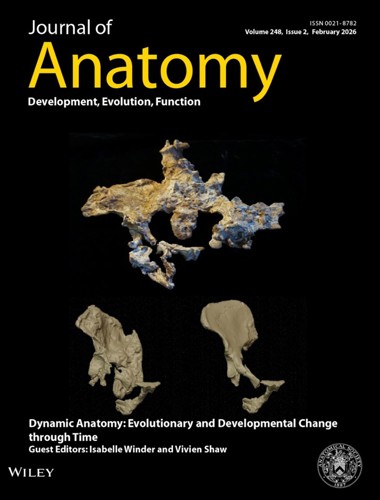
The cover image for the latest issue is from a paper by Crompton et al. titled ‘Bipedalism or bipedalisms: The os coxae of StW 573'.
The study aimed to analyze the pelvic (os coxae) morphology of the Australopithecus specimen StW 573 to assess variation in early hominin bipedalism. It found that StW 573’s pelvis is more human-like than many other australopiths, supporting the presence of multiple Australopithecus species and distinct forms of bipedal locomotion in early hominins.
Access the paper here
The cover image for the journal's January issue is shown below
Aging Cell
Aging Cell is a bi-monthly peer-reviewed, open access journal that aims to publish the highest quality, innovative research addressing fundamental issues in the biology of aging. We would like to remind you that our colleagues Aging Cell are now back on Twitter and sharing exciting news and updates on articles from their journal. Please give them a follow @aging_cell
Access the journal here: Aging Cell