
Editor Elena Patera
Welcome to the June issue of Anastomosis. In this issue, we bring you the latest news from our members and from the Journal of Anatomy and Aging Cell.
If you have any news, events or announcements that you would like to see published in the newsletter, please send us an email by the 20th of each month. Items should reach the editor a minimum of 30 days before the date that the event is scheduled to take place. Please remember that you can visit our News Page at any time for the very latest news.
Education Committee Paper of the Month
'Comparison between digital and physical anatomical specimens in a formative near-peer OSPE: Performance and perceptions in first-year medical students
Authors: Andreas Grøndalen, Hanne Dahl Vonen, Sabina Sagredo-Thackwell, Melanie Rae Simpson, Claudia Krebs, Michel van Schaardenburgh
Link to access the article: https://anatomypubs.onlinelibrary.wiley.com/doi/10.1002/ase.70187
The following review of this article was written by Professor Scott Border (University of Glasgow)
This mixed-methods study compared first-year medical students’ performance and perceptions during formative near-peer OSPE anatomy assessments using both digital 3D specimens and traditional physical specimens. Like many educational studies that are operating within a live curricula context, this one adopts the trusty ‘within subject’ cross over design (been there myself). This is of course a very reasonable methodological choice, given the circumstances, since it offers a robust control within the constraints of teaching. Despite that, the non-random allocation and region–modality confounding (knee vs shoulder) is likely to introduce some bias here and there.
Students completed shoulder and knee anatomy stations in alternating modality combinations, while researchers analysed assessment scores with linear mixed-effects regression and evaluated survey responses through thematic analysis. While the application of linear regression is actually a nice step up from a T-test, which many other authors would have applied by default here (me included!), the qualitative analysis lacks rigour due to AI-assisted coding without clear validation. There is no issue with the use of AI but how was it applied? Details of this need to become more common place in such studies, if it is to be adopted in this way (it probably will).
The overall aim of the study was to determine whether digital anatomy platforms could provide an educationally effective and scalable alternative to physical specimens within formative anatomy assessment. Did it do that? Well, yes but effect sizes are small, limiting inferential strength and conclusions are a little overstated: the terms valid and scalable exceed the evidence given the context-specific, formative, low-stakes conditions. It should be noted that the authors cautiously support blended, scalable OSPE preparation, not replacement of cadaveric teaching, btw – phew!
In summary, a nice little study that told us that first-year medical students performed similarly in formative near-peer OSPE anatomy assessments using digital 3D specimens compared with traditional physical specimens. This preliminary outcome bodes well for anyone trying to incorporate more formative assessment opportunities (to drive learning), as recommended by their institutional education strategy.
Would you like to tell the AS membership about your 'Tip of the Month', 'Anatomy Education Paper of the Month' or 'Anatomy Resource of the Month'?
We are looking for contributors who would be willing to write a short review on a 'Tip of the Month', 'Anatomy Education Paper of the Month' or 'Anatomy Resource of the Month. If you would like to contribute to an upcoming issue of Anastomosis, and join our bank of contributors please complete this form and we will be in touch!
Summary of Anatomical Society Webinar:
“Beyond Play – Implementing Serious Games in Anatomy Education”
June 2026
Dr Arthur Lau (NUS Yong Loo Lin School of Medicine) delivered an engaging session exploring how serious games can be meaningfully integrated into anatomy education. He opened by clarifying foundational terminology, noting that “games essentially are defined as a system in which players engage in an artificial conflict defined by rules and result in a quantifiable outcome”. He distinguished play, games, serious games, entertainment games, game‑based learning, and gamification, emphasising that educators often conflate these concepts.
A key message was that serious games prioritise learning over entertainment, whereas gamification simply adds game elements (e.g., points, leaderboards) to existing teaching. He highlighted the importance of aligning game mechanics with learning outcomes, explaining that misalignment can disengage learners. For example, he noted that some published studies show poorer performance when the game activity (e.g., tic‑tac‑toe) does not support the intended learning task.
Arthur also introduced the Garris Input–Process–Outcome model, explaining how learning occurs through repeated cycles of judgement, action, and feedback, akin to “learning through formative assessment”. He shared examples of games he has developed, such as MEDECK (integrating anatomy, histology, physiology, and clinical conditions) and AnaTWIST, designed to help students locate structures rather than merely recall definitions. He advised educators to “play more games… increase game literacy” to better understand mechanics and design possibilities. The session also presented findings from his qualitative research on anatomy educators’ perspectives. Barriers included limited time, unfamiliarity, stigma (“games are very childish”), and concerns about inclusivity and ethical design—particularly avoiding trivialisation of donor material. Arthur concluded with a proposed implementation framework addressing educator awareness, curriculum space, technical support, and inclusive design, aiming to reduce hesitancy and support gradual adoption of serious games in anatomy teaching.
You can watch the recording of the session here
Congratulations to the Latest Recipients of Anatomical Society Funding
If you would like to know more about how the Anatomical Society Funds our members, please see our full prize and funding matrix here. This month we would like to congratulate and latest recipients of the society's funding awards and provide you with the reports of the successful endeavours of recent awardees.
Anatomical Society Symington Bequest Travel Fund
The Trustees of the Symington Bequest Fund make grants to Society Members towards costs associated with the conduction and dissemination of anatomical research. Please see below the approved reports from recent awardees!
Round 3
Dr Rocky Cheung participated in the Anatomy Education Research Institute (AERI), Texas A&M University, School of Engineering Medicine in Houston, Texas, 1st to 4th June 2026. REPORT
Dr Rasyidah Rehir participated in Anatomy Advances 2026: Bridging Clinical and Surgical Anatomy for Medical Conference 2026, Birmingham, 25th to 26th May 2026 REPORT
Anatomical Society Public Engagement and Outreach Awards Reports
The Council of the Anatomical Society launched this initiative in June 2018 to support the public engagement and outreach activities of members of the Society in the field of Anatomy. Please see below the approved report of a recent awardee.
Round 3
Awardee: Dr Emma Jackson
Institution: University of Glasgow
Event dates: 8th to 9th June 2026
Venue: To be held at the Glasgow Botanic Gardens, Glasgow Activity
Title: Glasgow Science Festival, Cheers for 20 Years - The Brain Maps-Tabletop Activities
The Symington Memorial Prize 2026 Recipient
The Symington Memorial Prize was originally established in 1920 by the Queen's University of Belfast in commemoration of Professor Johnson Symington. The Prize is awarded by the Academic Council of Queen's University on the recommendation of the Council of Anatomical Society, which will seek the advice of its Education Committee.
We would like to congratulate Dr Wendy Birch, recipient of the Symington Memorial Prize 2026!
Deadlines for next round for Receipt of Applications
Award application deadline date for Round 5 of the 2025/2026 award year:
Symington Bequest
Barclay Smith Travelling Fund
Fellowship of the Anatomical Society
Public Engagement and Outreach
Departmental Seminar Awards
Deadline: 26.08.2026
Award application deadline date for Round 5 of the 2025/2026 award year:
Support for Student Societies
Deadline: 12.08.2026
N.B: Round 5 is the last round for academic year 2025/2026. The next round after this one, will be Round 1 of academic year 2026/2027 in October/November 2026 depending on the award.
PhD Studentship International Conference Report
The Anatomical Society PhD students are funded to present their work at one international conference during their PhD studies. Please see below the report of one of the AS-funded PhD students!
Ms Louise Hosty participated in the Tissue Engineering and Regenerative Medicine International Society (TERMIS) EU Chapter conference, in Palma de Mallorca, Spain, from 20-24th of April 2026.
Anatomical Society EDI Committee Vacancy
The Anatomical Society is inviting expressions of interest from its full members (including Early Career members) to join the Anatomical Society's Equality, Diversity and Inclusion (EDI) Committee for up to 3 years.
The aim of the Anatomical Society's EDI Committee is to advise Council on all EDI matters relating to the Society and its membership. The committee helps ensure that equality, diversity and inclusion are embedded across Society activities, policies, governance, meetings, awards, grants and membership engagement. More information on Anatomical Society EDI Committee members can be found by clicking on the link: https://www.anatsoc.org.uk/about-the-anatomical-society/committees/
We are seeking a committee member who has an interest in promoting equality, diversity and inclusion within the anatomical sciences community. Applicants should be committed to fostering an inclusive and welcoming environment and may have experience of EDI-related initiatives through teaching, research, leadership, student support, outreach, mentoring, policy development, committee work, or lived experience.
We welcome individuals from diverse backgrounds and career stages who can contribute thoughtful perspectives, engage constructively in discussions, and support the committee in advancing the Society's EDI objectives.
Participation in online discussions, virtual meetings and taking responsibility for aspects of our annual action plan would be expected as part of committee membership.
The Society encourages applications from those from underrepresented groups or those who have protected characteristics.
In reviewing your application, we will consider:
1. Your experience/interest of engaging with EDI-related initiatives
2. Evidence of collaborative working and constructive engagement
3. Motivation for joining the EDI Committee and alignment with its aims
Please apply through Application for Membership of the Equality, Diversity and Inclusion Committee 2026 – Fill out form
The deadline for application is 5pm on Friday 17th July 2026.
For enquiries, please email: Dr Caroline Curtin, Chair of the AS EDI Committee, at carolinecurtin@rcsi.ie.
PhD opportunity in Spinal Muscular Atrophy and Brain Research
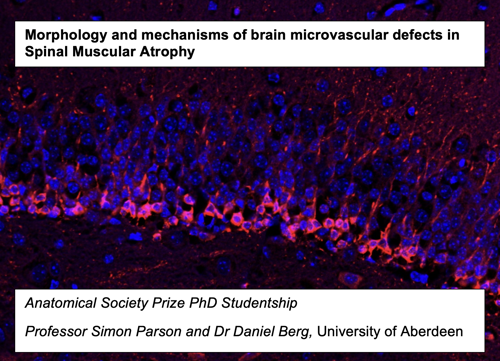
An Anatomical Society fully funded (UKRI Fees and stipend, plus paid attendance at 3 UK and 1 international conference) is available from October 2026.
Spinal muscular atrophy (SMA) is a rare form of motor neuron disease that predominantly affects the infant population. SMA was untreatable until 10 years ago, but now 4 effective therapies are available. However, new patient pathophenotypes are emerging, and it is likely this is due to originally sub-clinical defects which remain untreated, and which are now surfacing. Chief amongst these are neurodevelopmental and cognitive defects. In this new collaboration Professor Parson brings his expertise in SMA together with Dr Berg’s expertise in brain development. Our laboratory has lead in describing the importance of microvascular defects in SMA, and has recently developed a novel transgenic mouse model where SMA pathology is driven exclusively in the endothelial cells which line the cardiovascular system. The project will seek to define neurovascular defects in the brain, initially focussing on the hippocampus. The aim of the project is to determine if additional, combinatirial therapies are required to target non-neuromuscular defects in SMA patients. Techniques involved in the research include microdissection, tissue preparation, histology: sectioning, staining, and advanced microscopy, identification and quantification of pathophenotypes in mouse tissues and pathology in patient samples; molecular analysis, data analysis and presentation.
Informal enquiries in the first instance to: Professor Parson: simon.parson@abdn.ac.uk
Deadline: 21st of July 2026
Anatomy Research Developmental Awards 2026/2027
The Anatomical Society Council is pleased to announce the 2026/27, 'Anatomy Research Development Award' aimed at researchers in the early stages of their academic careers.
Applications are currently being invited from eligible researchers to commence in 2027. The closing date for applications is midnight 31st December 2026.
Anatomical Society Research Studentships 2026/27
Call for Applications
Applications are currently being invited from prospective supervisors for Research Studentships to be held in departments of anatomical sciences in the UK and Ireland starting October 2027. The closing date for applications is 5pm Wednesday 19th August 2026.
For the eighth year, the Society is reserving a studentship for an early career investigator (ECI). An ECI is a person with a lectureship or independent research fellowship who is within 12 years of being awarded a PhD, exclusive of career breaks, who has guaranteed employment for the duration of the studentship and who has not held an AS PhD Studentship previously. The application will be judged according to different criteria than the regular studentship submissions with more emphasis on project design and training provided than on track record. The proposal will still have to meet the high standard expected.
The advertisement, application forms, information and conditions can be found on the website:
Alternatively, contact the Honorary Secretary, Professor Joanna Matthan, care of maryanne.piggott@kcl.ac.uk
11th IFAA FIPAR Webinar June 30th 2026
Time: June 30th (Tue) 09:00 (UK), 10:00 (Central European Time), 13:00 (New Delhi), 16:00 (Beijing), 17:00 (Japan, Korea), 18:00 (Melbourne), 01:00 (Los Angeles)
Organized by Federative International Programme on Anatomical Research (FIPAR)
Program (timings are in UK Time)
09:00 – 09:05 Welcome and housekeeping (Han-Sung Jung, Yonsei University, Korea)
09:05 – 09:25 Dr. Yuki Hattori (Nagoya University, Japan) “ Microglial colonization and roles in early brain development ”
09:25 – 09:35 Q&A
09:35 – 09:55 Dr. Mi-Sun Hur (Daegu Catholic University, Korea) “ Decoding Muscular Architecture: An Integrative Approach Using Microdissection and Multimodal Analysis ”
09:55 – 10:05 Q&A
10:05 – 10:10 Closing Remark (Han-Sung Jung)
The Webinar will be held online in Zoom.
Please download the Zoom program before joining the meeting.
Join: https://us02web.zoom.us/j/85744897889?pwd=6KgQMJBNUhVxktNWDRbnUVS8aiMSie.1 Meeting ID: 857 4489 7889 Passcode: 278713
Upcoming Conferences
22nd Congress of the International Federation of Associations of Anatomists (IFAA), 13th-16th August 2026, Melbourne, Australia
Standard registration for the 22nd IFAA Congress is still available!
This is an opportunity to share our work, insights, and innovations with a global audience of colleagues and thought leaders in anatomy and related fields, including:
Anatomical Sciences Education
Surgical and Clinical Anatomy
Imaging Anatomy
Neuroscience and Cell Biology
Ethics and Law
Anatomy for Everyone, including Biological Anthropology, Forensics, Histology, Developmental Anatomy/Embryology
For more information regarding the registration, please visit this link: https://ifaa2026.org/en-AU/pages/registration/registration
5th Early Career Anatomists Conference
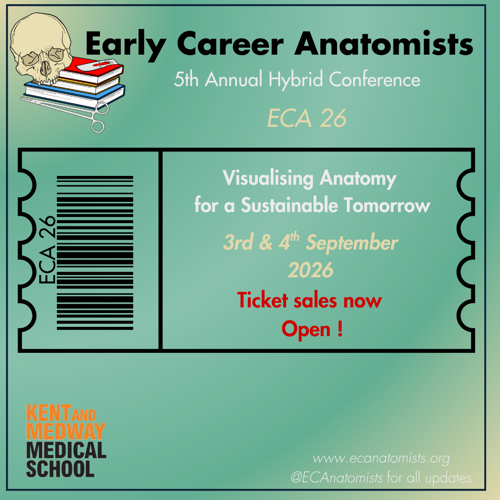
The Early Career Anatomists group is hosting their annual hybrid conference from September 3rd to 4th 2026 at Kent and Medway Medical School, Kent, UK.
If you are interested in attending, please check out the information below:
Journal of Anatomy
For a summary of many of the published articles check out @JournalofAnat. As a member of the Anatomical Society you have access to these articles and to the Journal of Anatomy through Wiley Online Library.
Access the journal here.
The cover image for the latest issue is from a paper by Suchánek, T., Huysseune, A. & Cerny, R. , titled 'The dental plate on bichir pectoral fins: A unique dermal skeletal element bearing individual odontodes with tooth-like replacement'.
The study aimed to investigate the development and structure of bichir dermal skeletal elements, especially odontocomplexes. It found a unique dental plate on the pectoral fins that combines a scale-like element with individual tooth-like odontodes. These odontodes are arranged in rows, show tooth-like replacement, and may help provide grip or support when bichirs rest on the substrate.
Access the paper here
The cover image for the journal's June issue is shown below:
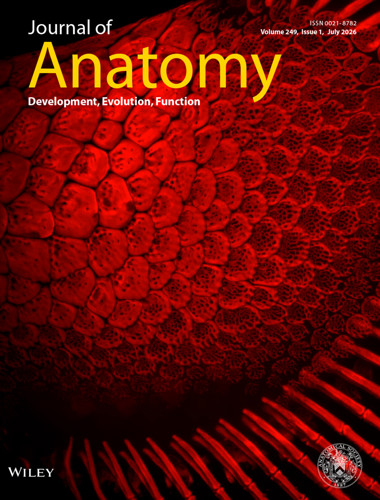
The cover image above shows the dental plate on bichir pectoral fins, a unique dermal skeletal element bearing individual odontodes with tooth-like replacement.
Aging Cell
Aging Cell is a bi-monthly peer-reviewed, open access journal that aims to publish the highest quality, innovative research addressing fundamental issues in the biology of aging. We would like to remind you that our colleagues Aging Cell are now back on X and sharing exciting news and updates on articles from their journal. Please give them a follow @aging_cell
Access the journal here: Aging Cell