
Editor Elena Patera
Welcome to the October issue of Anastomosis. In this issue, we bring you the latest news from our members and from the Journal of Anatomy and Aging Cell.
If you have any news, events or announcements that you would like to see published in the newsletter, please send us an email by the 20th of each month. Items should reach the editor a minimum of 30 days before the date that the event is scheduled to take place. Please remember that you can visit our News Page at any time for the very latest news.
Education Committee Resource of the Month
'Smart AI glasses in the DR. Question: Is that Smart'
Written by: Professor Claire Smith from Brighton and Sussex Medical School
Wearable smart glasses have rapidly shifted from niche gadgets to a fast growing market. I will confess I own two pairs (you gotta have sunglasses right!) and have been using them for 18 months. This is not product placement, and I am not advocating any brand.
Whilst stats vary it looks like over 10 million of them were sold in 2026 alone. The price has reduced: ~ £250 at introduction level. They have become less obvious and are heading to be mainstream.
As with many AI developments, there might be a degree of hesitation to ‘hold back the tide’ whilst we understand the technology and its implications. At the same time, excitement and exploration of what the new technology can offer. So what can they do? What can’t they do?
Can:
• Take Photos- from your point of view (POV)
• Take Videos- from your POV
• Live stream to main social media channels
• Play Music/audio books
• Provide Directions
• Read alerts/messages
• Translate live speech in various languages
• Offer voice prompts to AI searches ‘'tell me the name of the 5th cranial nerve'
• Some models display visual cues e.g. texts, directions.
One of the features I do like, is they can describe what you are looking at. It’s not great with anatomy yet, but look at a houseplant, a historical building, ask it to tell you what you are looking at and it does, and it has definitely saved a few house plants. Back to work, can I load up an MCQ paper and ask it to tell me which is the right answer? Yes. Is it accurate? Reasonably. I have been trying this out across different courses, so not just anatomy and medicine, and in short, if the information is on the web, it’s easy for it to find and answer. This includes MCQ with graphs to interpret which I thought was a higher level of taxonomy.
Can’t (at the moment):
• Replace smartphones. They don’t have every app and integration
• Last for ages. Battery life is still a limiting factor- depending on use. They last a work day, then charge in the case.
• Recognize faces
• Provide context aware AI
• Offer fully immersive AR/VR environments
• Operate without a smart phone
• Pay for coffee
• Have high quality GPS embedded
• Match the quality of health data gathered by wearable technology in watches/rings/earbuds
The below are a few pointers for consideration in this.
• Policy. What is the institutional policy that might cover this area? If there isn’t one, what are the closest areas and who has responsibility?
• Code of Conduct. What approach works for the ‘whole’. This doesn’t mean a blanket ban. But could mean it is written into a student facing code of conduct that Smart glasses are not permitted unless by prior agreement.
• Supportive. Explore the opportunities these offer for Reasonable Adjustments and how they could be adapted/used in the Lab. The glasses offer a wide range of features to support individuals; e.g. read the email in front of me, or they can support hearing.
• Human Tissue. Consider the aspects of data protection, HTA/patient/student/staff and privacy of the data and where it is stored.
Technology is likely to move fast in this space, Working with students and understanding their use of the technology will be key in developing policies and guidance which are both achievable and manageable. Worth of mention are the ethics around the companies, data, environmental concerns. These are all important and need to be linked into the own users choices, as well as institutional policies (where use is within University/NHS).
Meeting summary for AS Educational Research Workshop
'Getting started with data'
In this webinar hosted by the Education Committee, Dr William Kay, Senior Lecturer in Statistics at Cardiff University, challenged attendees to rethink how they approach data analysis in anatomy and health professions education research. Drawing on examples from the educational literature, he argued that effective analysis is not about selecting the “correct” statistical test from a flowchart, but about making informed analytical decisions that align with the research question, study design and type of data collected.
A central theme of the session was that researchers should begin thinking about analysis at the study design stage, rather than after data collection is complete. Dr Kay emphasised that the research question should drive decisions about both data collection and analysis, with careful consideration given to what researchers genuinely want to learn from their data. Using examples drawn from anatomy education research, he explored common challenges associated with analysing Likert-scale survey data, assessment scores and pre- and post-intervention datasets. Attendees were encouraged to think critically about the assumptions underlying different analytical approaches, recognise the limitations of commonly used methods, and consider alternative analyses that may provide richer or more informative insights.
The webinar also examined ongoing debates surrounding the analysis of Likert-scale data, highlighting that there is often more than one valid analytical approach depending on the assumptions being made and the questions being asked. Alongside quantitative methods, Dr Kay stressed the importance of qualitative research and demonstrated how approaches such as thematic analysis can be used to answer questions that numerical data alone cannot address.
The session concluded with a reassuring message: statistical expertise develops through patience, persistence, curiosity and critical thinking. Participants were encouraged to move beyond formulaic approaches to data analysis, be transparent about assumptions and caveats, and view analysis as a process of thoughtful decision-making rather than simply selecting a statistical test.
Couldn’t attend? Will’s presentations slides are available here and the recording can be accessed here. Future educational seminars will be advertised in Anastomosis and on the Anatomical Society social media platforms – if you have a topic suggestion please email schannon@rvc.ac.uk
Congratulations to the Latest Recipients of Anatomical Society Funding
If you would like to know more about how the Anatomical Society Funds our members, please see our full prize and funding matrix here. This month we would like to congratulate and latest recipients of the society's funding awards and provide you with the reports of the successful endeavours of recent awardees.
Anatomical Society Symington Bequest Travel Fund
The Trustees of the Symington Bequest Fund make grants to Society Members towards costs associated with the conduction and dissemination of anatomical research. Please see below the reports from some of our most recent awardees!
2025/2026 Round 3
Dr Joy Reidenberg participated in the 22nd Congress of the International Federation of Associations of Anatomists (IFAA), ‘Anatomy for Everyone’, Melbourne, Australia, 13th to 16th August 2026. REPORT
Deadlines for next round for Receipt of Applications
Award application deadline date for Round 1 of the 2026/2027 award year:
Symington Bequest
Barclay Smith Travelling Fund
Fellowship of the Anatomical Society
Public Engagement and Outreach
Departmental Seminar Awards
Deadline: 11.11.2026
Award application deadline date for Round 2 of the 2026/2027 award year:
Support for Student Societies
Deadline: 04.02.2027
Expressions of Interest for joining the Anatomical Society's Website, Media and Communications Committee
The Anatomical Society is inviting expressions of interest from any of its members to join the Anatomical Society's Website, Media and Communications Committee (WMCC) for up to three years.
The aim of the Anatomical Society's WMCC is to provide timely information to members and non-members about the Society’s activities and achievements in anatomical education and research, promoting the tangible benefits and added value of being a member of the Society.
The WMCC are seeking two new committee members who have particular experience of using social media in a professional capacity and/or experience of newsletter editing. Experience of image creation/editing for media distribution would also be highly desirable.
The successful applicant would be required to attend 2-4 meetings per year, some online, and some in person. Usually, one of these meetings will take place during the Society's Summer or Winter Meeting, for which, one night's accommodation, standard class travel and subsistence will be funded by the Society. Participation in recruitment of new members, online discussions and taking responsibility for assigned aspects of the annual action plan (e.g., developing social media presence, editing and development of the monthly newsletter Anastomosis and contributing to the website) will be expected, as part of committee membership.
The Society particularly encourages applications from those from underrepresented groups or those who have protected characteristics. To apply, please complete the application form here.
The deadline for applications is midnight on Tuesday, 10th November 2026.
For enquiries, please email: maryanne.piggott@kcl.ac.uk c/o Dr Catherine Hennessy (Chair of the Website, Media and Communications Committee Anatomical Society)
Royal Society of Biology Committee Recruitment
Teaching Policy Advisory Group member recruitment
The RSB is seeking up to five members to join the RSB Teaching Policy Advisory Group (TPAG). TPAG will provide input from those with teaching, initial training and CPD expertise, to inform RSB policy positions, and develop a programme of work to address the current issues in school-level teaching across all four UK nations. Group members will have an important role in advising on and representing the Society's views on teaching policy for wider impact through a range of activities in relation to: initial teacher education (ITE), subject-specific CPD, teacher retention, raising the professional status of teachers in all educational settings, making sure teachers are being supported to develop their subject-specific knowledge, and deployed appropriately within their subject discipline. The RSB education policy priorities provide further information. For further information and the full job posting, please visit mySociety.
Applications close on Sunday 8th November 2026, 23:59 BST.
Curriculum Committee member recruitment
The RSB is seeking up to six new members to join its Curriculum Committee, chaired by Professor Dudley Shallcross OBE FRSB. The Committee plays a key role in shaping the Society's vision for biology education and ensures the biology curriculum at all educational stages is as relevant as possible and prepares students for their next steps in life. It also oversees and promotes the recommendations set out in the Society's Evolving 5-19 Biology framework. Committee members will have the opportunity to contribute to the development of RSB education policy positions, influence discussions around curriculum reform, and help ensure high-quality biology education is accessible to learners across all four UK nations. For further information and the full role description, please visit mySociety.
Applications close on Sunday 8th November 2026 at 23:59 BST.
Upcoming Anatomical Society General Meeting Council
The Annual General Meeting of the Anatomical Society will be held on Tuesday 15th December 2026 at Trinity College Dublin, Ireland during the Society’s Winter Meeting, 14th to 16th December 2026.
Exact time of the AGM will be announced later.
Anatomy Research Developmental Awards 2026/2027
The Anatomical Society Council is pleased to announce the 2026/27, 'Anatomy Research Development Award' aimed at researchers in the early stages of their academic careers.
Applications are currently being invited from eligible researchers to commence in 2027. The closing date for applications is midnight 31st December 2026.
Upcoming Conferences
Anatomical Society Winter Meeting
2026
The Anatomical Society is pleased to announce that the Winter Meeting 2026 will take place between 14th-16th December 2026, at the Trinity Biomedical Sciences Institute, Pearse Street D02R590, and at the Anatomy Building D02PN40, Trinity College Dublin, Dublin, Ireland.
The theme of the meeting is 'Skin and Bone'
This proposed meeting of the Anatomical Society will explore the themes of Skin and Bone, emphasising the structural, functional, and immunological interplay between the integumentary and musculoskeletal systems.
Scientific sessions will showcase innovative research from across Ireland to include skin and bone, orthopaedics, tissue engineering, immunology, and general anatomyspanning topics from microanatomy and development to immune function in tissue homeostasis, repair, pedagogy and disease. Invited lectures from leading researchers will highlight the translational relevance of tissue engineering and surgery.
The meeting will also include satellite workshops focused on the growing need for dialog around anatomy collections and their legacy, and the role of virtual dissection and AI in contemporary medical education. The meeting will also feature a visit to the Anatomy Museum and Lecture Theatre first established in 1825.
The conference dinner will celebrate Irish tradition, providing an opportunity for delegates to experience local cuisine. Hosted at TCD, the meeting will benefit from a central, accessible location in a city renowned for its rich cultural heritage, vibrant academic environment, and international connectivity.
Other highlights include
Pre-conference:
• Exploring the Future of Anatomy Education Through the Lens of AI
• TBF: How to publish in Anatomy and JoA
Tour: Anatomy museum and Old Anatomy Lecture Theatre. Invited Keynotes and speakers include: Prof Fergal O’ Brien (Royal College of Surgeons Ireland), Dr Eimear Dolan (University of Galway), Prof Desmond Tobin (University College Dublin), Prof Sarah Snelling (University of Oxford), Prof David Hoey (Trinity College Dublin), Dr Eoin O' Cearbhaill (University College Dublin), Prof Claire Smith (University of Sussex), more to follow.
The Anatomical Society Young Investigator Oral Presentation Prize will be awarded at this meeting. See website for more details: https://www.anatsoc.org.uk/grants-prizes/prizes/young-investigator-prize/
Further details about the conference can be found on our website: https://www.anatsoc.org.uk/annual-events/anatomical-society-winter-meeting-2026/
Journal of Anatomy
For a summary of many of the published articles check out @JournalofAnat. As a member of the Anatomical Society you have access to these articles and to the Journal of Anatomy through Wiley Online Library.
Access the journal here.
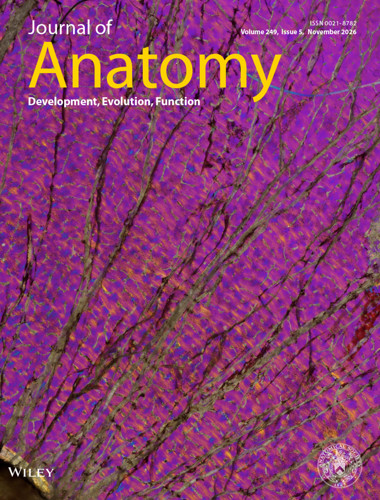
The cover image for the latest issue is from a paper by Valerie Trinidad et al. (2026), titled 'Comparative histological analysis of vertebrates reveals Triassic climate variability across southern Pangea'
The study aimed to investigate how climate influenced growth and development in different Triassic vertebrates across southern Pangea using bone histology, and it found that Zimbabwe had a more arid but less seasonal climate, where faster growing dinosaurs and cynodonts grew rapidly and continuously, while slower growing rhynchosaurs and suchians experienced more frequent interruptions in growth.
Access the paper here
The cover image for the journal's October issue is shown below:
Aging Cell
Aging Cell is a bi-monthly peer-reviewed, open access journal that aims to publish the highest quality, innovative research addressing fundamental issues in the biology of aging. We would like to remind you that our colleagues Aging Cell are now back on X and sharing exciting news and updates on articles from their journal. Please give them a follow @aging_cell
Access the journal here: Aging Cell
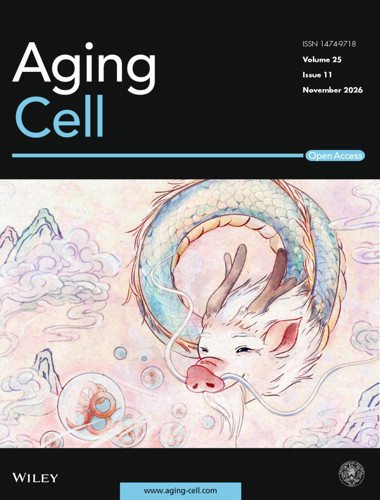
The cover image for the latest issue is from a paper by Yaoyu Zhang et al. (2026), titled 'The Senokine Gas6 Promotes Aortic Valve Calcification Through CaMKII–DRP1–Mediated Terminal Scission of Mitochondrial-Derived Vesicles'.
The study aimed to determine how mitochondrial derived vesicles contribute to the spread of calcification in calcific aortic valve disease and how their release is regulated, and it found that Gas6 promotes vesicle release through the CaMKII DRP1 pathway, increasing calcification, while inhibiting this pathway or deleting Gas6 reduces calcification and disease progression.
Access the paper here
The cover image for the journal's October issue is shown below:
Vacancies
Anatomy Demonstrator Human Anatomy Resource Centre, University of Liverpool For more information about this post please click here | Job Title | Anatomy Demonstrator |
Contract Type: | Full-time Tenure: Fixed term maternity cover expected to be from December 2026 until November 2027 | |
Organisation: | Human Anatomy Resource Centre, University of Liverpool | |
Remuneration: | £33,951 per annum | |
Closing Date: | 2nd of November 2026 23:30 |
Human Anatomy Unit Deputy and Lab Manager For more information about this post please click here | Job Title | Human Anatomy Unit Deputy and Lab Manager |
Contract Type: | Full-time Permanent | |
Organisation: | Department of Surgery & Cancer, Imperial College London | |
Remuneration: | £48,246 to £58,318 per annum | |
Closing Date: | 13th of November 2026 |