
Editor Elena Patera
Welcome to the September issue of Anastomosis. In this issue, we bring you the latest news from our members and from the Journal of Anatomy and Aging Cell.
If you have any news, events or announcements that you would like to see published in the newsletter, please send us an email by the 20th of each month. Items should reach the editor a minimum of 30 days before the date that the event is scheduled to take place. Please remember that you can visit our News Page at any time for the very latest news.
Key Insights and Reflections from the 22nd Congress of the International Federation of Associations of Anatomists 2026
Written by Elena Patera, Editor of the Anatomical Society’s monthly newsletter, Anastomosis
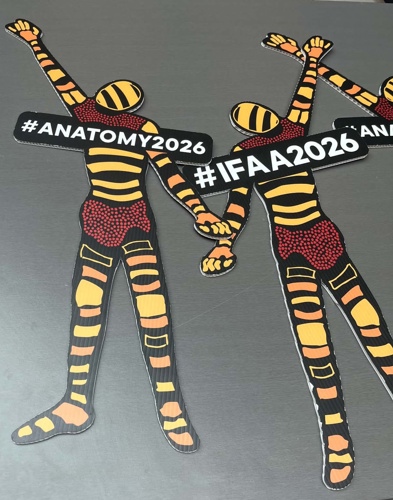
Recently, I had the opportunity to attend the 22nd Congress of the International Federation of Associations of Anatomists (IFAA), themed ‘Anatomy for Everyone’, which took place from the 13th to the 16th of August in Melbourne, Australia.


The pre-congress workshops held on the first day shared one overarching theme, making anatomy more practical, technologically enabled and accessible. Nine workshops were available, covering digital and AI-enhanced education, applied and living anatomy, educational communication and media, anatomy education research, advanced imaging and the use of 3D models to support equitable access.
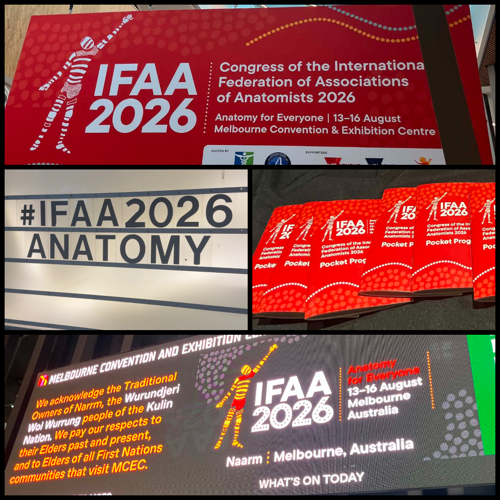
On the evening of the first day, I attended the welcome reception, where fellow delegates and I had the opportunity to network while enjoying the amazing night-time views of Melbourne’s Yarra River and high-rise buildings.


During days 2–4 of the congress, several sessions were held across four main domains.
1. Anatomical Sciences Education
2. Anatomy for Everyone
3. Ethics, Law and Humanities
4. Surgery and Clinical Anatomy
I also attended Symposium #84, titled ‘Training the Trainer, Continuing Professional Development in Anatomy Education’, chaired by Dr Hannah Shaw, Professor Tracey Wilkinson, Dr Kat Sanders and Dr Lauren Clunie.
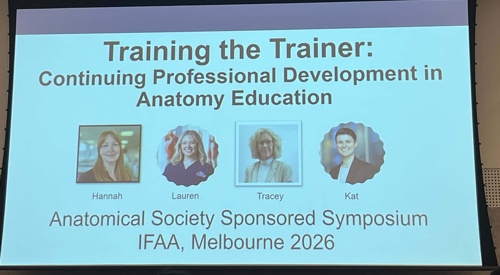
During this symposium, we considered a key question: What knowledge and skills should be included in an anatomy education curriculum to prepare educators in anatomical sciences, ethics, professionalism and governance, educational research and scholarship, and effective teaching practice?
We were assigned to groups consisting of delegates with varying levels of teaching experience and expertise. Each group was asked to discuss and rank the knowledge and skills considered important for inclusion in an anatomy education curriculum across four categories:
1. Anatomy knowledge, including gross anatomy, histology, embryology, clinically applied anatomy, imaging and dissection skills
2. Ethics, professionalism and governance
3. Educational research and scholarship, including research ethics and quantitative and qualitative research methods
4. Anatomical education, including teaching approaches, the use of technology, learning theories and reflective practice
There was considerable overlap in the knowledge and skills that delegates considered important, although individual priorities differed according to each delegate’s professional background and educational qualifications.
We also had the opportunity to learn how anatomy organisations, including the Anatomical Society and the American Association for Anatomy, support anatomy educators throughout their academic journey. It is not uncommon for anatomy educators to enter academia and begin teaching anatomy after completing anatomy-related courses or gaining clinical experience, but without formal training in teaching. Examples of such support include the Anatomy Training Programme (ATP), which allows anatomy educators to enhance their anatomical knowledge of the entire human body, practise their dissection skills and reflect on their learning.
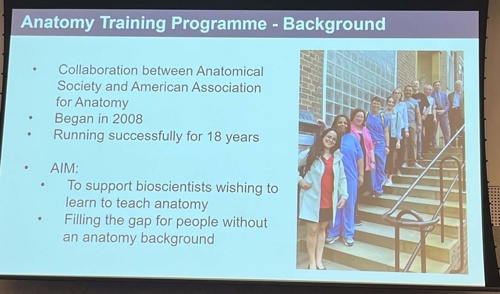
Another challenge discussed during the symposium was how anatomy educators may enter academia without receiving training in pedagogy or in conducting educational research using quantitative or qualitative methods. The Education Committee of the Anatomical Society helps address this challenge by running online webinars. During these webinars, anatomy educators with experience in pedagogical research cover key areas and provide guidance to help colleagues with less experience get started in educational research. Furthermore, financial support provided to members by anatomy societies and organisations, such as the Symington Bequest Travel Fund, which the Society kindly awarded me, also gives anatomy educators the opportunity to attend conferences and congresses. Attending workshops, listening to presentations and learning about the work of fellow anatomists help us build the knowledge and confidence needed to engage in pedagogical research
The main take-home messages I gained from the congress are the following:
• After attending Symposium #74, ‘Addressing the Needs of Global Challenges in Attaining Ethically Sourced Bodies, Are There Alternate Frameworks as Practical Solutions?’, the main take-home message was that ethics is not black and white, and we need to become more comfortable navigating the grey areas.
• After listening to an enlightening plenary talk titled ‘Anatomy, Racial Scientism and Eugenics in Australia’, I reflected on the importance of developing Artificial Intelligence (AI) literacy as AI becomes increasingly integrated into higher education. We must remain mindful of how AI models are trained, whose data they use and how they may perpetuate scientific racism in new forms.
• A shared view was that anatomy is for everyone. However, access to education and opportunities is not equal. When geography can define a person’s future, what can we, as anatomists and educators, do to help address these inequalities?
Overall, one common feature I continue to observe across regional, national and international anatomy conferences and congresses is how driven anatomy educators are to make a meaningful impact on their students and change the world for the better. Their passion for teaching, learning and research is reflected in the excellent initiatives they develop, a shared trait among anatomy educators, irrespective of where in the world they come from! I am grateful to the Anatomical Society for supporting my attendance at this congress, which provided me with a valuable opportunity to expand my knowledge, present my work, build professional networks and further my professional development.
Education Committee
Teaching Tip of the Month
'Understanding human development with the aid of the Human Developmental Biology Resource Atlas'
Written by : Robert H. Anderson from Newcastle University
Quite some time ago, in a similar “teaching tip”, Michelle Welsh, along with two student interns from the University of Glasgow, emphasised the value of virtual histology. I can fully appreciate the challenges they described when the microscope was used to provide cellular details. But it is a long since I first studied human anatomy. At that time, in 1960, anatomy occupied a great proportion of the 2nd MB curriculum. Multiple lectures were devoted to human development, but it was a difficult subject to grasp. Having become proficient, by the 1980’s, in the understanding of human cardiac anatomy, my colleague and I, in an inflammatory article, suggested that, when seeking to understand maldevelopment of the heart, the accounts of normal development then available were a hindrance rather than a help. Major changes have now forced me to eat my words. These changes are now available to all thanks to the emergence of the Human Developmental Biology Resource Atlas.
I have used the resource primarily to underscore my ongoing investigations into cardiac development. I was unaware of the extent of its Atlas until seeking to provide this recommendation for its use. It is truly remarkable. It is arguable that the content of the Atlas is far too great for those wishing to learn no more than the basics of human development, but everything within the Atlas is presented in user-friendly fashion. The proof of the pudding will, of course, be in the eating. Those using the site will themselves be able to judge whether my own appreciation is based on my own prior knowledge. For starters, however, the neophyte can first get to grips with the stages of human development by browsing the models that show the stages described long since by those working in the Carnegie Institute in USA. The models themselves extend beyond the end of the embryonic stage, where Carnegie stops, and continue into the fetal stages, which are equally well-illustrated. It is then a relatively easy matter to progress to the models provided for all the important systems of organs. Those who by this time are hooked can proceed to examine the e-histology sections. If not exhausted by this time, they can continue by exploring the section of the Atlas containing models of the developing organs. Detailed information is provided relative to the formation of the cardiovascular system, the eye, the gastrointestinal tract, the inner ear, the nervous system, the pituitary gland, and the urogenital system. In their recommendation of the system providing virtual histology, Michelle Welsh and her interns were able to point to overwhelming positive feedback. I can do no more than offer my own opinion. I wish the resource had been available when I was learning the rudiments of human development.
Congratulations to the Latest Recipients of Anatomical Society Funding
If you would like to know more about how the Anatomical Society Funds our members, please see our full prize and funding matrix here. This month we would like to congratulate and latest recipients of the society's funding awards and provide you with the reports of the successful endeavours of recent awardees.
The Barclay-Smith Travelling Fund Recipients
The Anatomical Society awards the Barclay-Smith Travelling Fund to AS members to support their attendance at the Anatomical Society Winter or Summer meetings. Congratulations to our most recent awardee!
2025/26 Round 5
Ms Emily Green - to participate in the Anatomical Society Winter Meeting, Trinity College Dublin, Ireland. 14th to 16th December 2026.
Anatomical Society Symington Bequest Travel Fund
The Trustees of the Symington Bequest Fund make grants to Society Members towards costs associated with the conduction and dissemination of anatomical research. Please see below the reports from some of our most recent awardees!
2025/2026 Round 2
Dr Eiman Abdel Meguid participated in the 22nd Congress of the International Federation of Associations of Anatomists (IFAA), ‘Anatomy for Everyone’, Melbourne, Australia, 13th to 16th August 2026. REPORT
Dr Mutahira Lone participated in the 22nd Congress of the International Federation of Associations of Anatomists (IFAA), ‘Anatomy for Everyone’, Melbourne, Australia, 13th to 16th August 2026. REPORT
Dr Munesh Khamuani participated in the 22nd Congress of the International Federation of Associations of Anatomists (IFAA), ‘Anatomy for Everyone’, Melbourne, Australia, 13th to 16th August 2026. REPORT
Dr Sourav Bhattacharjee participated in the 22nd Congress of the International Federation of Associations of Anatomists (IFAA), ‘Anatomy for Everyone’, Melbourne, Australia, 13th to 16th August 2026. REPORT
2025/2026 Round 3
Ms Jemima Chukwu participated in the 22nd Congress of the International Federation of Associations of Anatomists (IFAA), ‘Anatomy for Everyone’, Melbourne, Australia, 13th to 16th August 2026. REPORT Photo
2025/2026 Round 4
Dr Shane Browne participated in the 22nd Congress of the International Federation of Associations of Anatomists (IFAA), ‘Anatomy for Everyone’, Melbourne, Australia, 13th to 16th August 2026. REPORT
Professor Kieran McDermott participated in the 22nd Congress of the International Federation of Associations of Anatomists (IFAA), ‘Anatomy for Everyone’, Melbourne, Australia, 13th to 16th August 2026. REPORT
Anatomical Society Public Engagement and Outreach Awards Reports
The Council of the Anatomical Society launched this initiative in June 2018 to support the public engagement and outreach activities of members of the Society in the field of Anatomy. Congratulations to our most recent awardees!
Year 2025/2026
Round 5
Awardee: Dr Megan Kruskie
Institution: University of Aberdeen
Event Dates: A two-part event: 27th September 2026 in Elphinstone Hall, University of Aberdeen and 15th October 2026 at the Suttie Centre, University of Aberdeen
Activity Title: ‘Celebrating World Anatomy Day 2026 – Anatomy for Everyone’
Awardee: Dr Marta Perera Perez
Institution: Guy’s Hospital, King’s College London
Event Date: 17th October 2026
Activity Title: ‘Dry Mouth Dialogues’ – A patient/researcher/clinician collaborative workshop
Awardee: Dr Rebecca Quinn
Institution: University of Sunderland, at the Fire Station Sunderland
Event Date:18th October 2026
Activity Title: ‘Discover Anatomy Day’ to showcase anatomy to school children and the public across Sunderland to raise aspirations with regards to studying medicine etc. Part of a series of events with a wide variety of staff and student volunteers to deliver a programme of events centred around World Anatomy Day.
Anatomical Society Departmental Seminar Grants
The Anatomical Society awards grants to provide financial support to visiting speakers for seminars. Congratulations to the latest recipient of this award! Below is also a report from a recent awardee.
2025/26 Round 2
Award Holder: Dr Ourania Varsou
Hosted By: University of Glasgow
Date: Tuesday 15 September 2026
Key Speaker: Dr Eiman Abdel-Meguid, Queen’s University Belfast
2025/26 Round 5
Award Holder: Dr Gwenllian Tawy
Hosted By: University of Manchester
Date: 23 November 2026
Key Speaker: Ms Joanna Cameron, Medical and Scientific Artist
Event: Creative Body project – Medical Art Seminar
New Fellows of the Anatomical Society
Following the September 2026 Council, the Anatomical Society is happy to announce that the following individuals have received the Anatomical Society Fellowship! Many congratulations to our most recent AS fellows!
Round 5 (Elected by 09.09.26 Council):
Dr Chun Guo
Dr Arjuna Ratnayaka
Dr Alana Sharp
Dr Sophie Miller Memorial Prize Awardee Report
Dr Sophie Miller Memorial Prize Lecture 2026 awardee Ms Lauren Barrett, University College Cork (UCC), Ireland, delivered a talk titled 'Uncovering the potential of SKOR1 as a novel therapeutic target for Parkinson’s Disease’ at the Anatomical Society Summer Meeting, 15th to 17th July 2026, hosted by the University of Bristol.
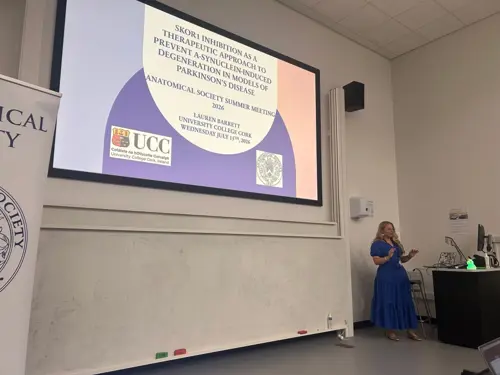
Parkinson’s Disease is a common brain disorder that affects the coordination of movements. It is a progressive disease caused by an excess of a misfolded protein known as α-Synuclein causing the death of dopamine producing neurons, and there is currently no cure. SKOR1 is a protein that has previously been shown to be present at higher levels in experimental models of Parkinson’s Disease. We have found that reducing the levels of SKOR1 in laboratory models of Parkinson’s Disease protect against the damage caused by the α-Synuclein protein. We also know that aging is a major risk factor for Parkinson’s Disease, so we are using mice at various ages to examine the expression of SKOR1, α-Synuclein and related proteins in dopamine producing neurons across the lifespan as they age. Together, we hope that this work will bring us closer to discovering a new treatment for Parkinson’s Disease.
Deadlines for next round for Receipt of Applications
Award application deadline date for Round 1 of the 2026/2027 award year:
Symington Bequest
Barclay Smith Travelling Fund
Fellowship of the Anatomical Society
Public Engagement and Outreach
Departmental Seminar Awards
Deadline: 11.11.2026
Award application deadline date for Round 1 of the 2026/2027 award year:
Support for Student Societies
Deadline: 28.10.2026
New Fellow of the Year Award
The Anatomical Society will present a New Fellow of the Year Award to the Fellow of the Anatomical Society who has demonstrated the most significant accomplishments relative to their career stage. The New Fellow of the Year will be selected from those elected to Fellowship during the previous academic year. Congratulations to Professor Emerita Helen Nicholson for being selected as the soceity's New Fellow of the Year!
PhD Studentship International Conference Reports
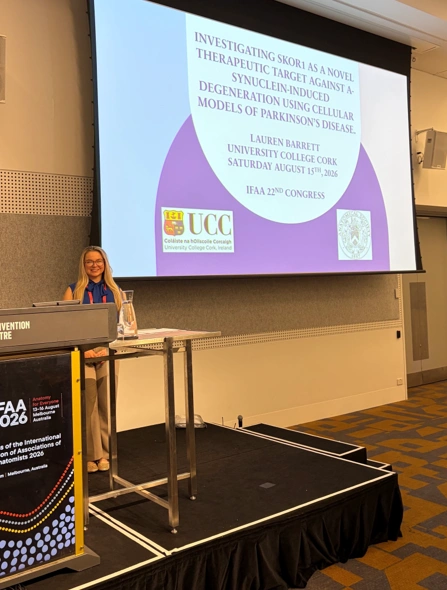
Anatomical Society PhD students are funded to present their work at one international conference during their PhD studies. Please read below the approved report from AS-funded PhD Student Ms Lauren Barrett!
PhD Studentships - International Conference Reports 2026
Ms Lauren Barrett participated in the 22nd Congress of the International Federation of Associations of Anatomists 2026, August 13-16th, Melbourne, Australia.
Anatomical Society Undergraduate Awards 2025/26
Please see below the approved reports for two of the society's undergraduate awards for academic year 2025/2026
Applicant: Dr Ian Woods
Institution: Royal College of Surgeons in Ireland (RCSI)
Student: Ms Laoise McAuley
Project Title: Flexi-Stim: Flexible Electrodes with Anatomical Shape Memory for Therapeutic Electrical Stimulation
Applicant: Professor James Sleigh
Institution: UCL Queen Square Institute of Neurology (QSION), University College London
Student: Ms Magdalena Georgieva
Project Title: Morphological evaluation of motor and sensory neurons in a new mouse model for SORD neuropathy
Anatomical Society Council Elections 2026/27
The Anatomical Society invites nominations from members to serve on Council beginning on Tuesday 15th of December 2026.
The Invitation Letter and Nomination Form including Instructions on how to complete and return the Nomination Form can be found by clicking on the following link: https://goto.rsb.org.uk/rsbbvvhh
The deadline for nominations to reach c/o maryanne.piggott@kcl.ac.uk is midnight Tuesday 6th October 2026.
Upcoming Anatomical Society General Meeting Council
The Annual General Meeting of the Anatomical Society will be held on Tuesday 15th December 2026 at Trinity College Dublin, Ireland during the Society’s Winter Meeting, 14th to 16th December 2026.
Exact time of the AGM will be announced later.
Anatomy Research Developmental Awards 2026/2027
The Anatomical Society Council is pleased to announce the 2026/27, 'Anatomy Research Development Award' aimed at researchers in the early stages of their academic careers.
Applications are currently being invited from eligible researchers to commence in 2027. The closing date for applications is midnight 31st December 2026.
Upcoming Conferences
Anatomical Society Winter Meeting
2026
The Anatomical Society is pleased to announce that the Winter Meeting 2026 will take place between 14th-16th December 2026, at the Trinity Biomedical Sciences Institute, Pearse Street D02R590, and at the Anatomy Building D02PN40, Trinity College Dublin, Dublin, Ireland. The theme of the meeting is 'Skin and Bone'
This proposed meeting of the Anatomical Society will explore the themes of Skin and Bone, emphasising the structural, functional, and immunological interplay between the integumentary and musculoskeletal systems.
Scientific sessions will showcase innovative research from across Ireland to include skin and bone, orthopaedics, tissue engineering, immunology, and general anatomyspanning topics from microanatomy and development to immune function in tissue homeostasis, repair, pedagogy and disease. Invited lectures from leading researchers will highlight the translational relevance of tissue engineering and surgery.
The meeting will also include satellite workshops focused on the growing need for dialog around anatomy collections and their legacy, and the role of virtual dissection and AI in contemporary medical education. The meeting will also feature a visit to the Anatomy Museum and Lecture Theatre first established in 1825.
The conference dinner will celebrate Irish tradition, providing an opportunity for delegates to experience local cuisine. Hosted at TCD, the meeting will benefit from a central, accessible location in a city renowned for its rich cultural heritage, vibrant academic environment, and international connectivity.
Other highlights include
Pre-conference:
• Exploring the Future of Anatomy Education Through the Lens of AI
• TBF: How to publish in Anatomy and JoA
Tour: Anatomy museum and Old Anatomy Lecture Theatre. Invited Keynotes and speakers include: Prof Fergal O’ Brien (Royal College of Surgeons Ireland), Dr Eimear Dolan (University of Galway), Prof Desmond Tobin (University College Dublin), Prof Sarah Snelling (University of Oxford), Prof David Hoey (Trinity College Dublin), Dr Eoin O' Cearbhaill (University College Dublin), Prof Claire Smith (University of Sussex), more to follow.
The Anatomical Society Young Investigator Oral Presentation Prize will be awarded at this meeting. See website for more details: https://www.anatsoc.org.uk/grants-prizes/prizes/young-investigator-prize/
Further details about the conference can be found on our website: https://www.anatsoc.org.uk/annual-events/anatomical-society-winter-meeting-2026/
Journal of Anatomy
For a summary of many of the published articles check out @JournalofAnat. As a member of the Anatomical Society you have access to these articles and to the Journal of Anatomy through Wiley Online Library.
Access the journal here.
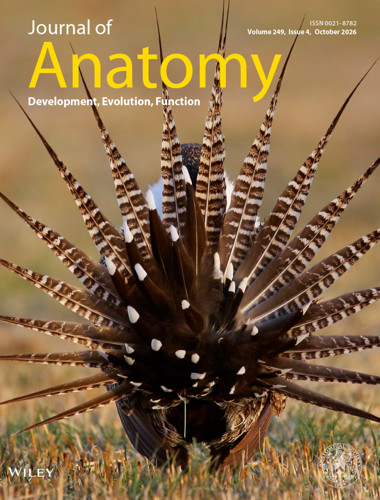
The cover image for the latest issue is from a paper by Alexander D. Clark et al. (2026), titled 'Courtship display behavior influences tail myology in Centrocercus minimus (Gunnison sage-grouse)'.
The study compared the tail muscles of Gunnison sage-grouse with those of birds that do not fan their tails during courtship and found that the muscles used to raise and spread the tail fan are especially well developed, suggesting that courtship displays have shaped the species’ anatomy.
Access the paper here
The cover image for the journal's September issue is shown below:
Aging Cell
Aging Cell is a bi-monthly peer-reviewed, open access journal that aims to publish the highest quality, innovative research addressing fundamental issues in the biology of aging. We would like to remind you that our colleagues Aging Cell are now back on X and sharing exciting news and updates on articles from their journal. Please give them a follow @aging_cell
Access the journal here: Aging Cell
Vacancies
Senior Technician (Anatomy) For more information about this post please click here | Job Title | Senior Technician (Anatomy) |
Contract Type: | Full time, permanent | |
Organisation: | Canterbury Christ Church University | |
Remuneration: | £32,080 - £34,610 per annum | |
Closing Date: | 1st of October 2026 |
Anatomy Facility Manager For more information about this post please click here | Job Title | Senior Technician (Anatomy) |
Contract Type: | Permanent | |
Organisation: | Brighton and Sussex Medical School | |
Remuneration: | Grade 7 starting at £38,784 to £46,049 per annum, pro rata if part time. | |
Closing Date: | 1st of October 2026 |
Anatomy Teaching Technician (x2) For more information about this post please click here | Job Title | Teaching Fellow in Anatomical Sciences |
Contract Type: | First post: full-time Second post: part-time | |
Organisation: | Anatomy Suite, University of Nottingham | |
Remuneration: | £26,908 to £28,890 per annum, (or pro rata if applicable) depending on skills and experience. | |
Closing Date: | 2nd of October 2026 |
Teaching Fellow in Anatomical Sciences For more information about this post please click here | Job Title | Teaching Fellow in Anatomical Sciences |
Contract Type: | Full time, permanent | |
Organisation: | Southampton General Hospital | |
Remuneration: | £36,636 to £44,746 per annum | |
Closing Date: | 8th of October 2026 |