
Editor Elena Patera
Welcome to the February issue of Anastomosis. In this issue, we bring you the latest news from our members and from the Journal of Anatomy and Aging Cell.
If you have any news, events or announcements that you would like to see published in the newsletter, please send us an email by the 20th of each month. Items should reach the editor a minimum of 30 days before the date that the event is scheduled to take place. Please remember that you can visit our News Page at any time for the very latest news.
Education Committee Teaching Tip of the Month
'Giving Feedback to Students'
Written by Olivia Murray (University of Edinburgh)
Feedback is provided to students at many points throughout their educational journey and across a variety of learning environments. One of the most challenging contexts for educators is the delivery of verbal feedback. Because this form of feedback involves direct, personal interaction, it requires careful consideration. If not managed effectively, such interactions can quickly become uncomfortable for both the educator and the student.
In seeking to improve both the fluidity of my interactions with students and the quality of the feedback I provided, I was introduced to Pendleton’s Model of feedback (Pendleton, 1984). This model promotes student-led reflection by encouraging learners to evaluate their own performance before receiving external input. It places emphasis on recognising strengths while also constructively identifying areas for improvement, supporting a balanced and reflective approach to learning.
Pendletons Model of Feedback
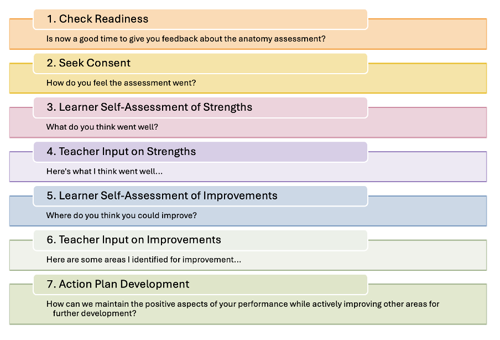
Image adapted from Pendleton (1984).
The cycle begins by ensuring the student is ready to receive feedback. This helps establish psychological safety, supports mental preparedness, and respects personal boundaries. By doing so, feedback is more readily received and understood, fostering a collaborative, constructive, and growth-oriented dialogue.
It progresses by seeking to understand the context in which the student’s assessment took place. This stage allows the student to share their perspective, including their understanding of the assessment, how they felt it went, and any relevant factors that may have influenced their performance.
The next step provides an opportunity for both student and teacher to identify areas of strength. Reinforcing strengths can enhance motivation, engagement, and confidence. By exploring the student’s perspective on their performance, the teacher gains insight into how they view successes, helping tailor feedback. For instance, if a student feels confident in an area I thought needed improvement, I can reframe feedback in a more constructive and receptive way.
Next the model guides the conversation towards identifying points for development. When students identify their own areas for improvement, they take ownership of their weaknesses, which reduces defensiveness and encourages reflective practice. In addition, the teacher can build on their self-assessment rather than surprising them with an extensive list of feedback.
The model concludes with the development of a plan for improvement. The role of the educator here is key as appropriate resources can be identified and alignment created with the course or module goals. This action plan will be specific to the student and provide future reference points for the teacher to check in with.
The advantage of this model over approaches such as the feedback sandwich or CEDAR lies in its capacity to consider the context in which assessment occured and to promote student reflection. The importance of self-assessment should not be underestimated, as students often already know the areas they need to improve upon. This approach allows them to take ownership of their development while simultaneously strengthening their reflective skills.
References
Pendleton, D. (1984). The Consultation: An Approach to Learning and Teaching. Oxford: Oxford University Press.
Pendleton, D., Schofield, T., Tate, P. and Havelock, P., 2003. The new consultation: developing doctor-patient communication. OUP Oxford.
Would you like to tell the AS membership about your 'Tip of the Month', 'Anatomy Education Paper of the Month' or 'Anatomy Resource of the Month'?
We are looking for contributors who would be willing to write a short review on a 'Tip of the Month', 'Anatomy Education Paper of the Month' or 'Anatomy Resource of the Month. If you would like to contribute to an upcoming issue of Anastomosis, and join our bank of contributors please complete this form and we will be in touch!
Congratulations to the Latest Recipients of Anatomical Society Funding
If you would like to know more about how the Anatomical Society Funds our members, please see our full prize and funding matrix here. This month we would like to provide you with the reports of the successful endeavours of our recent awardees.
The Symington Bequest Travel Fund
The Trustees of the Symington Bequest Fund make grants to Society Members towards costs associated with anatomical research. Below is a report from a recent awardee.
Round 5 of Academic Year 2024/2025
Dr Dhamyaa AL-Halboosi - to participate in the 2025 British Society for Neuroendocrinology (BSN) Meeting, Bradford, 31.08.25 to 03.09.25. REPORT
Barclay Smith Travelling Fund
The Anatomical Society awards grants to its members towards costs associated with attending AS meetings. Below is a report from a recent awardee.
Round 1 2025/2026
Ms Avanthika Sivakumar participated in the Anatomical Society Winter Meeting, Anglia Ruskin University, Chelmsford, 17th to 19th December 2025.
Deadlines for next round for Receipt of Applications
Award application deadline date for round 3 of the 2025/2026 award year:
Symington Bequest
Barclay Smith Travelling Fund
Fellowship of the Anatomical Society
Public Engagement and Outreach
Departmental Seminar Awards
Deadline: 15.04.2026
Award application deadline date for round 2 of the 2025/2026 award year:
Support for Student Societies
Deadline: 01.04.2025
N.B: For academic year 2025/2026 onwards, there will only be 5 prize rounds and council meetings.
Young Investigator Oral Presentation Prize Winner and Runner Up 2025 Award
The following award was made at the 2025 Winter Meeting, 17th to 19th December 2025, Anglia Ruskin University (ARU), Chelmsford:
Young Investigator Oral Presentation Prize 2025
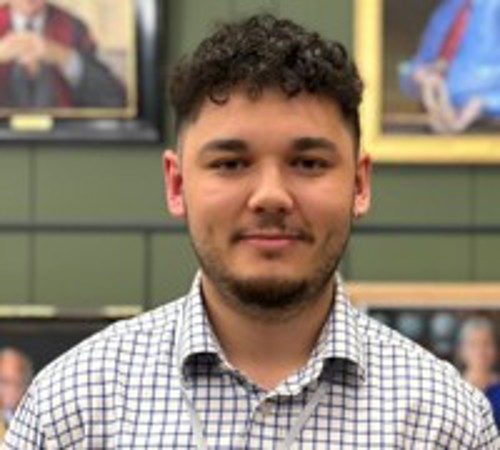
Awardee: Mr Brandon Boyer
University: Anglia Ruskin University (ARU), Chelmsford
Oral Presentation: Neuroanatomy of cranial dural vessels: implications for dural arteriovenous fistula (DAVF) embolization
The following award was made at the 2025 Winter Meeting, 17th to 19th December 2025, Anglia Ruskin University (ARU), Chelmsford:
Runner-Up Young Investigator Oral Presentation Prize 2025
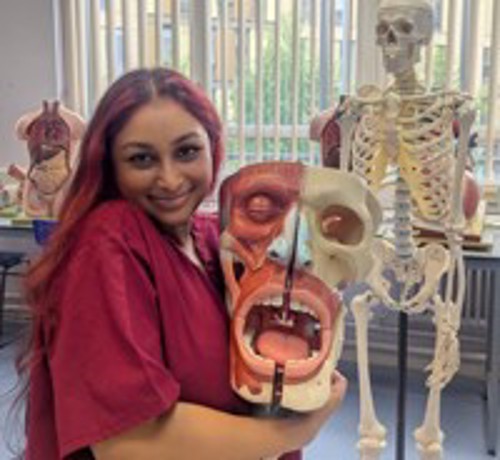
Awardee: Ms Millie Patel
University: University of Leicester
Oral Presentation: We’re censoring ourselves:’ Evaluating Student Experiences While Learning Pelvic Anatomy’.
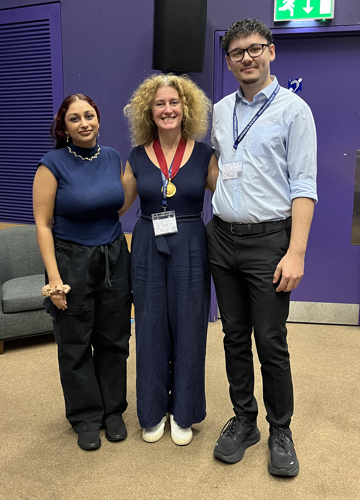
Below is an image of the Young Investigator Oral Presentation Winner Mr Brandon Boyer and Runner Up Ms Millie Patel, with the new president of the Anatomical Society Professor Abigail Tucker at the Anatomical Society Winter Meeting 2025 at Anglia Ruskin University, Chelmsford.
Congratulations to Brandon and Millie!
Undergraduate Student Summer Vacation
Research Scholarships 2026
Applications are currently being invited from prospective supervisors to commence a scholarship for up to a 10-week period in the summer vacation of 2026. The closing date for applications is midnight Friday 20th March 2026. Further details and an application form (including Terms and Conditions) can be found by clicking on the link below:
Undergraduate Student Summer Vacation
Research Scholarships Reports 2024/2025
The USVRS 2024/25 Approved Reports have now been uploaded to the Society’s website. If you would like to check out the approved reports, please click on the following link: https://anatsoc.org.uk/grants-prizes/grants/undergraduate-summer-vacation-research-scholarships/awards-made-for-2025/
Fully-Funded PhD Opportunity
Fully Funded PhD Opportunity at Lancaster University, UK
I am currently recruiting for a fully funded PhD studentship at Lancaster Medical School with project titled “Anatomical Variation of Coronary Artery Branching and Its Clinical Implications for Coronary Artery Disease.” This competition-funded project (UK students only) will investigate how variations in coronary artery anatomy influence haemodynamics, plaque distribution, and clinical outcomes in coronary artery disease. The studentship includes Home (UK) tuition fees, a stipend at UKRI rates, and a bench fee allowance. The deadline for applications is Friday 6 March 2026.
Link to Call: https://www.findaphd.com/phds/phd-research-project/lancaster-university/?420y040
Dr. Benedicta Quaye Mensah (FHEA)
Assistant Professor (Anatomy) / Director MBCHB Year 1, Journal Editor (Institute of Anatomical sciences), Lancaster Medical School Faculty of Health and Medicine Lancaster University, Health Innovation One Sir John Fisher Drive, LA1 4AT, Lancaster
Upcoming Conferences
22nd Congress of the International Federation of Associations of Anatomists (IFAA), 13th-16th August 2026, Melbourne, Australia
Call for Abstracts has NOW been extended until the 28th of February 2026!
 This is an opportunity to share our work, insights, and innovations with a global audience of colleagues and thought leaders in anatomy and related fields, including:
Anatomical Sciences Education
Surgical and Clinical Anatomy
Imaging Anatomy
Neuroscience and Cell Biology
Ethics and Law
Anatomy for Everyone, including Biological Anthropology, Forensics, Histology, Developmental Anatomy/Embryology
Extended Submission Deadline: Saturday 28 February 2026, 23:59 (AEDT).
Submit your abstract and learn more: https://ifaa2026.org/en-AU/pages/program/call-for-abstracts
Journal of Anatomy
For a summary of many of the published articles check out @JournalofAnat. As a member of the Anatomical Society you have access to these articles and to the Journal of Anatomy through Wiley Online Library.
Access the journal here.
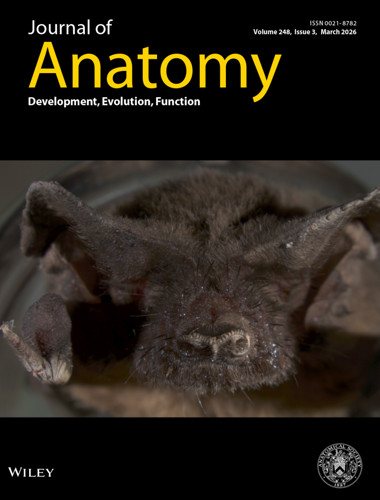
The cover image for the latest issue is from a paper by R. Carter, titled ‘A computational model of pinna tubercle aerodynamics in the fast-flying bat, Tadarida brasiliensis’
The study aimed to determine whether leading-edge tubercles on the pinna of the bat Tadarida brasiliensis improve aerodynamic performance, and it found that the tubercles enhanced efficiency by reducing drag near stall and increasing lift post-stall through the generation of streamwise vortices.
Access the paper here
The cover image for the journal's February issue is shown below and is titled: 'Face and leading edges of the pinnae of the Tadarida brasiliensis specimen'
Aging Cell
Aging Cell is a bi-monthly peer-reviewed, open access journal that aims to publish the highest quality, innovative research addressing fundamental issues in the biology of aging. We would like to remind you that our colleagues Aging Cell are now back on Twitter and sharing exciting news and updates on articles from their journal. Please give them a follow @aging_cell
Access the journal here: Aging Cell
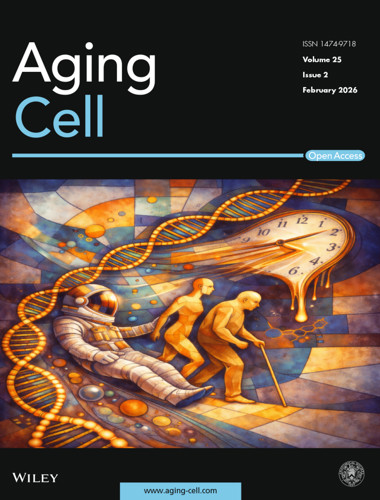
The cover image for this month is based on the article 'Astronauts as a Human Aging Model: Epigenetic Age Responses to Space Exposure' by Matías Fuentealba et al. (2026)
The study aimed to determine whether spaceflight accelerates biological aging using DNA methylation-based age metrics, and it found that astronauts experienced rapid but reversible epigenetic age acceleration during flight that returned to or below pre-flight levels after returning to Earth.
Access the paper here
Vacancies
Department of Biomedical Sciences, University of Birmingham
For more information about this post please click here. | Job Title | Assistant Professor in Anatomy (Education) |
Contract Type: | Permanent | |
Organisation: | College of Medicine and Health - Biomedical Sciences - School of Inflammation, Infection and Immunology - Department of Biomedical Sciences, University of Birmingham | |
Remuneration: | £47,389 to £56,535 Grade 8 | |
Closing Date: | 06/03/2026 |